
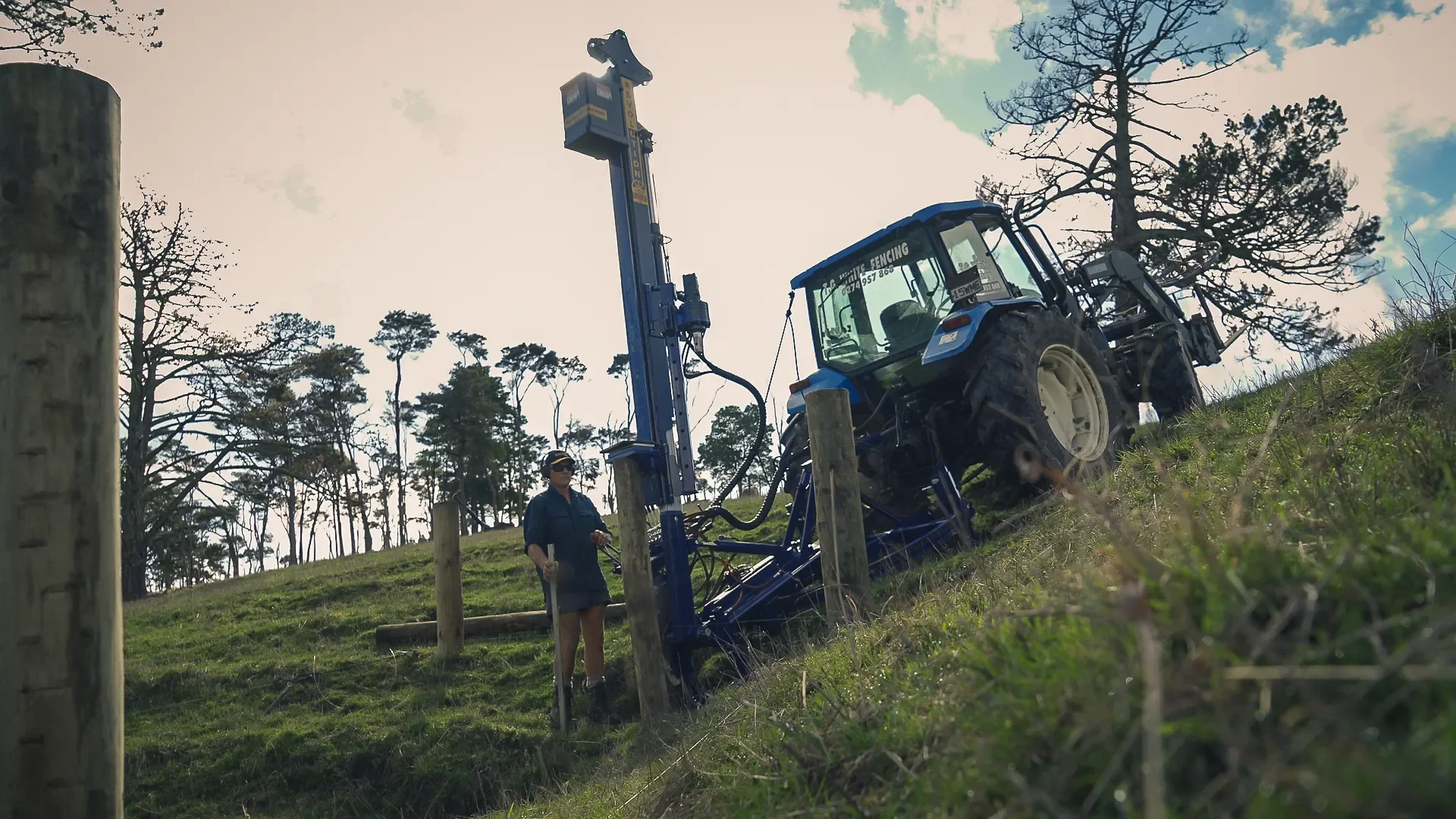
About Revolution Postdrivers
Revolution Postdrivers makes the world's first rotational post driver — and a range of machines built around the same design philosophy. Below is the story behind it, the engineering decisions that come out of it, and why our oldest machines are still working in NZ paddocks at 25 years old.
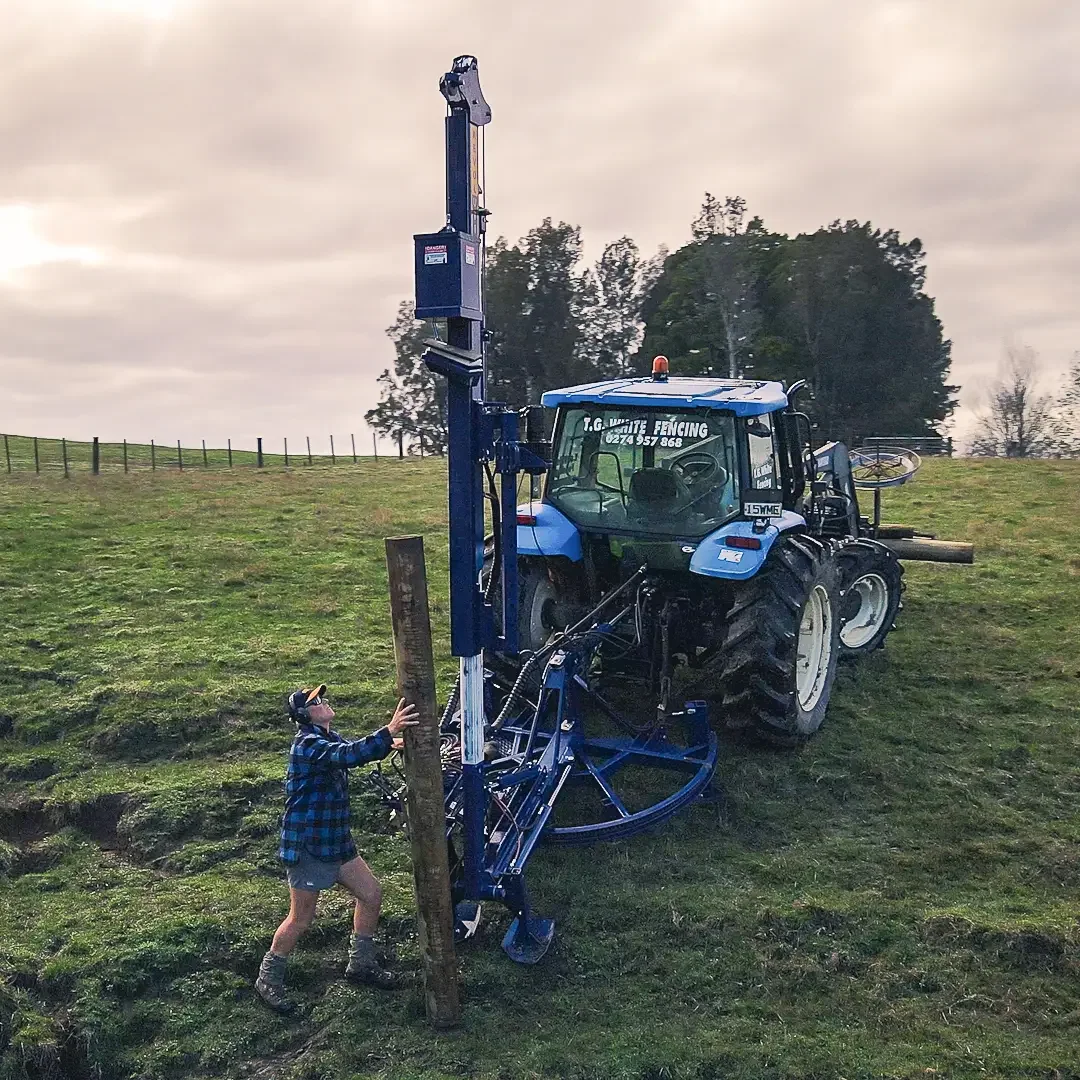
Designed in the dirt, on a wooden nail crate
Revolution was dreamed up and designed by Tony White, owner of White Fencing — a Kiwi fencing contractor who'd already spent over 20 years on the fence line before he ever drew the first prototype.
From a cigarette packet to NZ Fieldays
The idea began while Tony was sitting on a wooden nail crate having his lunch, drawing the basis of what would become the rotational Telescopic 180 in the dirt at his feet. He took that sketch to his mate, an engineer and built the first iteration shortly after.
In 2003, that machine — the Telescopic 180 — won the Equipment Improvement Award at NZ Fieldays. The same year, Revolution Postdrivers became a registered brand and the world's first rotational post driver hit the market. For roughly 20 years, no other manufacturer had a rotational. Today, several do. The difference is 30+ years of refinement, real-world testing, and design input from someone who actually fences for a living.
"I could break it too"
We are ourselves first and foremost fencers. Tony can still be found most days on the fence line, working with his crews at White Fencing — Revolution's working testing ground. Every model in the range gets used in earnest on Tony's own jobs before it ships to a customer. Every wear point, every stress point, every operator complaint surfaces in his hands first — and gets fixed before any customer ever sees it.
That's why Tony tends to laugh when someone challenges the design and tells him they could break it. "I could break it too," he'll say. "You want me to break it? I'll break it." The standard isn't unbreakable — it's that the machines last longer than every alternative on the market while staying maintainable when they do eventually wear. When you pick up a Revolution, you'll notice things other machines don't think about — because they were designed by someone who's never had to stand behind one for eight hours.
The post driver does the moving — not the tractor
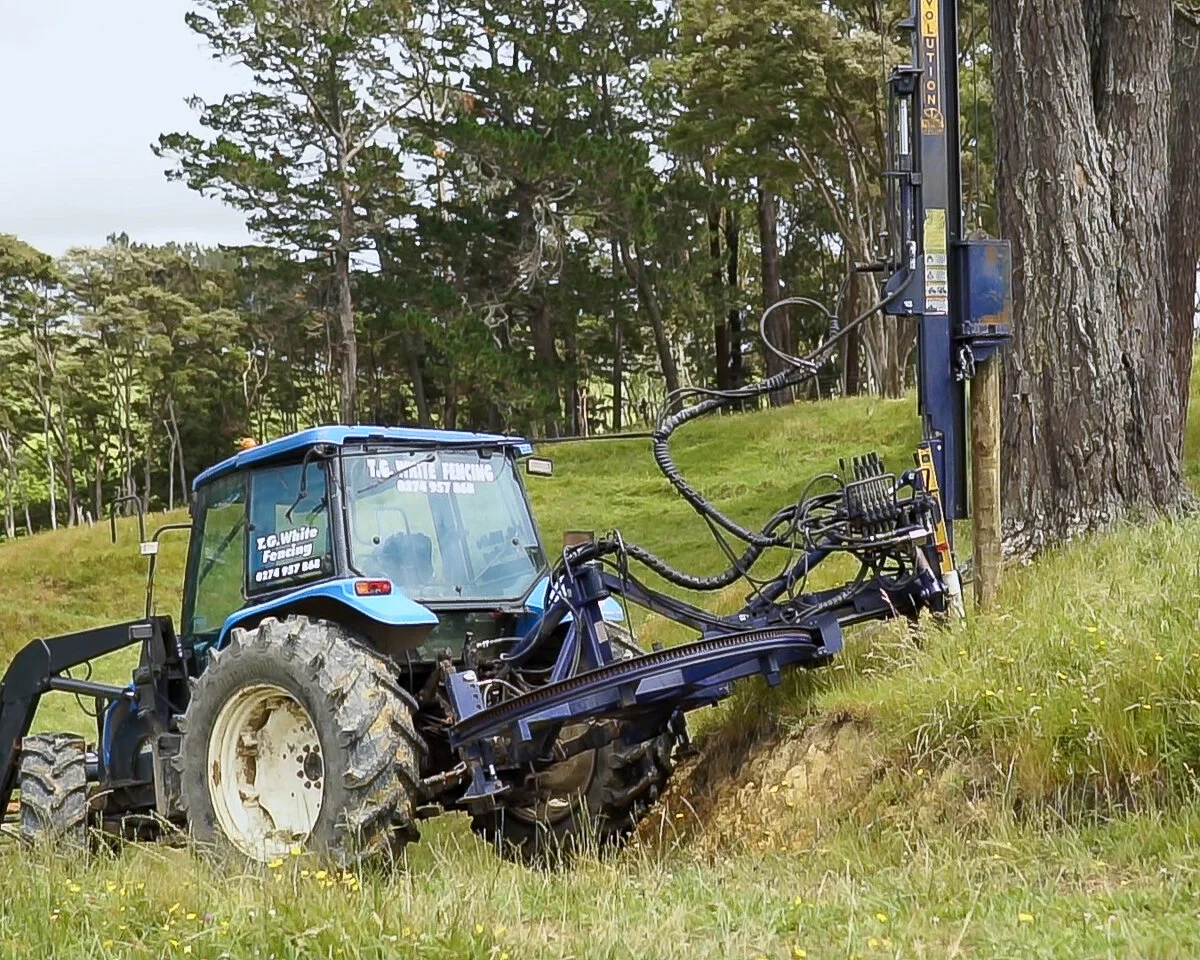
Most post drivers are designed around the tractor. You position the tractor, the machine drives a single post in a single position, you reposition the tractor, repeat. Tony designed Revolution around a different idea: keep the tractor still, move the post driver. The base rotates, side-shifts, or extends; the telescopic mast handles the height; the operator works from the same position regardless of where the next post is going. That single design decision drives almost everything else.
Engineered strong where it counts
Where other manufacturers add more steel to solve a problem, Revolution solves it with smarter design. Engineered strong where the stress is, deliberately light where it isn't — so most NZ fencing tractors (85–110 hp) can run a Revolution without upgrading the tractor itself. Other rotationals on the market need 120 hp+. Revolution doesn't. The result is a higher strength-to-weight ratio and better inherent balance, which means less wear on the post driver and the machine carrying it.
Built for hill country
Rotational machines are designed with inherent balance — particularly important on the hill country most NZ contractors are working. You can slew the machine from the cab as you drive, shifting weight to the uphill side as you go. The tractor stays where it's safe and balanced; the rammer comes to where the work is. You're not jeopardising your vehicle on awkward angles to reach a post.
All Revolution models also compact down for travel — keeping you safe under power lines and bridges, folding back into a machine that travels nicely between jobs. When you get to the next paddock, they unfold into an incredible scope of movement through the combination of base movement and telescopic mast.
One person, one position, multiple posts
The founding principle behind every Revolution model is one-operator, one-position, multiple-posts. With a conventional fixed machine, you're constantly getting on and off the tractor, repositioning, lining up. With a Revolution, the post driver does the moving while the operator stays put.
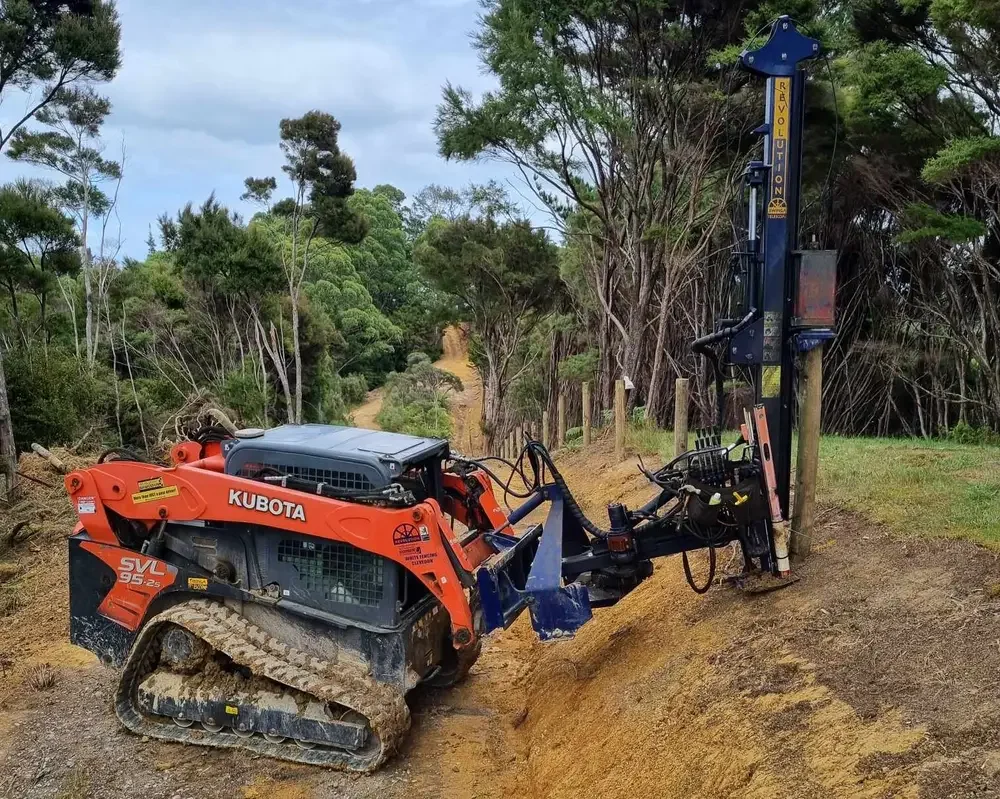
It's also why most of our customers run their machines as part of a system, not as a single-purpose driver. A skid steer plus a Revolution does fence-line prep, post pulls, post-hole augering, and rock-spike work — on top of everything a skid steer does on its own. One platform, multiple jobs, fewer machines on the trailer.
It's a different way of thinking about a post driver. Once you get it, you won't go back.
Built to be repaired, not replaced
Most equipment is designed to last as long as it can — until the day the rotation assembly fails or the mast face cracks, and the machine becomes uneconomical to repair. Tony designed Revolution around a different principle: build the parts that get a hiding to be replaceable. Protect the expensive parts. The result is machines that don't need to be replaced — they get serviced and keep going.
The expensive parts, protected
Components that may take a hit in the field — like leg towers — are designed to be the sacrificial point, because replacing a leg is simple and cheap. Replacing a rotation assembly is not.
The same logic applies at every wear point. UHMWPE bushes around the main hinge pin can be swapped out to tighten tolerances back up rather than replacing the machine. Post cap backbones are profile-cut from a single block of steel, not welded together from separate pieces. Bisalloy mast faces (Australian-made high-strength steel) are replaceable every 5–7 years without touching the mast structure. Sandblasted and two-pack paint as standard — closer to a car finish than the rough industrial coat that's typical of the trade.
"When the main hinge pin wears, you replace the bushes — that tightens it back up. We added a grease nipple to keep water out. That's why these are still working after 25 years." — Tony White
Why these are still working at 25 years old
The oldest Revolutions in the field are now 25 years old and still working. That's not luck. It's the design philosophy applied at every wear point on every machine.
It also opens a market behaviour that's structurally unavailable to most competitors: an active secondhand market. An 8-year-old Revolution credibly delivers another 12 to 20 years for the next operator — so machines move from one fencing operation to another rather than getting scrapped.

Made in NZ. Family-led. Globally relevant.
Built by hand in South Auckland
Right from the beginning, Revolution Postdrivers have been manufactured in New Zealand. D.R. Howells Engineering in Tuakau, South Auckland have been making Revolutions in-house since 2003 — supporting local businesses in our back-yard while letting us guarantee uncompromising quality. Parts are sourced locally too. When you need a wear pad, a bush, or a replacement plate, it's available — not waiting in a container off the East Coast.
Backed by Kiwi ingenuity
New Zealand's pastoral farming systems and varied terrain have led to fencing products that's seen NZ manufacturers widely considered as world leaders in fencing systems, machinery, tools and products. Our fencing contractors have exceptionally high skill levels and profitable systems; our farmers are some of the best in the world; many of them choose the long-term investment a Revolution makes. The whole brand is the No. 8 Wire mentality at work — thinking outside the square, tackling a problem head-on, and engineering a better answer than what's on the market.
Small operation, global relevance
Revolution today is a small, family-led business. Tony designs and operates the machines through White Fencing. Debbie runs the company day-to-day — sales, marketing, distribution, the relationships behind the brand. The business is now exporting to the United States via Kencove Farm Fence Supplies, with growing inquiries from Australia and the UK.