Same Price, Two Post Drivers: How to Spot the Better One
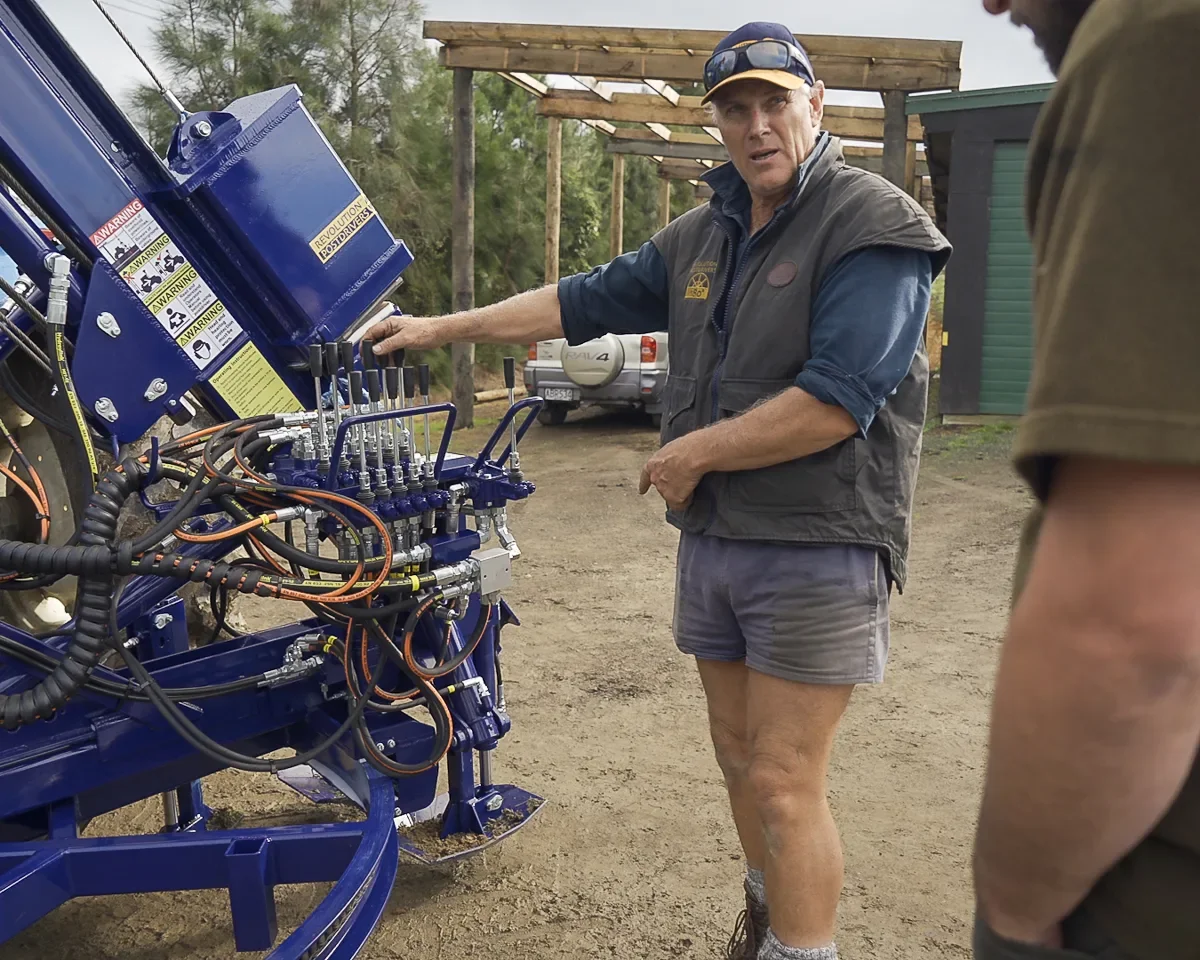
Tony White explaining the valve bank to a new Revolution owner.
Compare the flagship post drivers, the top of the range from each brand, and they look much the same on paper, and they cost around the same too. So how do you tell which one's actually better? You have to know what to look for, and most buyers don't, because the bloke selling it usually didn't design it. It's like going to buy a new ute and asking how they got the two-inch lift, whether it's just harder springs or proper geometry, what the bushes are even made of: he hasn't a clue, and getting a straight answer is like pulling teeth. A post driver's no different.
We design the Revolution range, and I still fence with it every day. Here's what I'd tell you to look at, roughly in the order it hits your wallet, so you can judge for yourself why I reckon a Revolution is the better buy at a similar price.
What matters most when choosing a post driver?
Weight and balance, straight off the bat, that's what matters most, and it's the detail most buyers overlook. Get them right and the machine travels on a smaller tractor, handles better on the hills, and costs you less to run for its whole life. Get them wrong and you pay for it every day, in tractor size, fuel, and where you can get to. Hitting power, the right accessories for your ground, and how long it lasts all matter too, but a heavy, unbalanced rig undermines the lot.
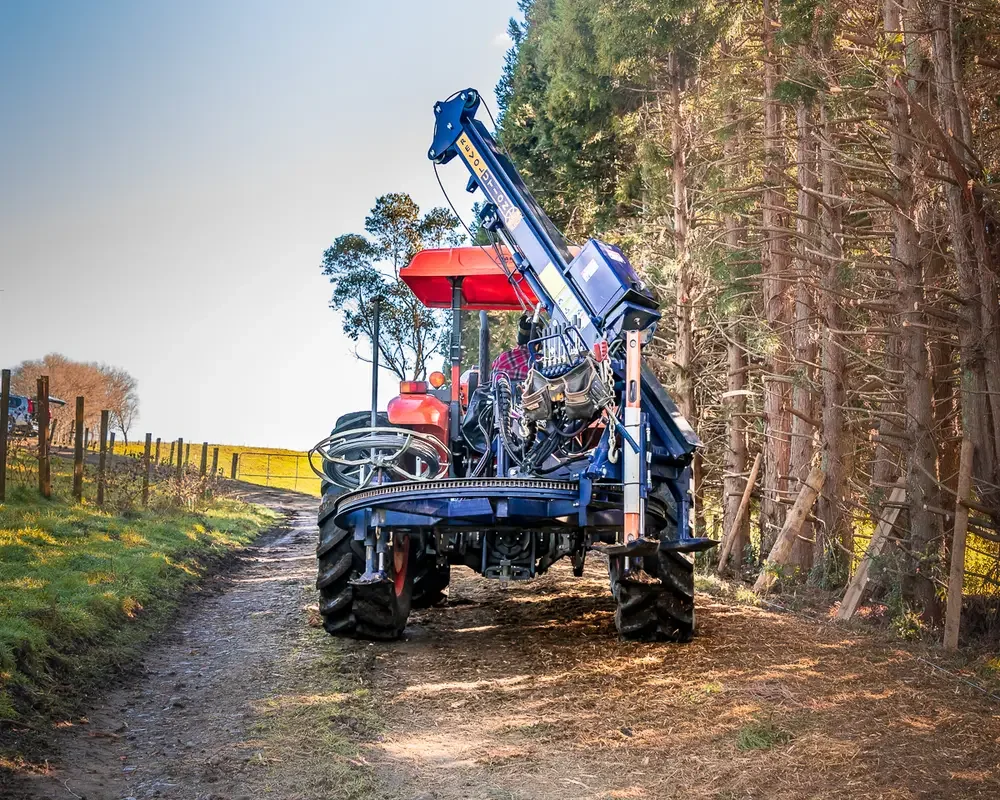
A Revolution 180 in the wild
Balance, not just weight
It's not just weight, it's balance. A heavy machine needs a bigger tractor, obviously. But a light one that's badly balanced needs a big tractor too, because if the weight's hanging out to the side or the back, the tractor has to be heavier just to stay safe and steady under it. A poorly balanced 1.2 or 1.4-tonne rammer can put you on a bigger tractor than a well-balanced Revolution of the same weight. A kitted-out Revolution 180 can run on a 75-horsepower four-wheel-drive tractor, around 4 tonnes, with the tractor about NZ$85,000. The heavy, badly balanced gear pushes you up to 150 horsepower or more: 7.2 tonnes, with the tractor in the NZ$185,000 to $200,000 range. The machine on the back might cost the same as mine, but the rig underneath it doesn't, and that jump in the tractor costs more than the post driver ever will.
We build every machine around balance, not just so it's steady when it's planted and driving a post, but so it sits right when you're carrying it across a face. The mast tucks back close to the tyre so the weight sits where you want it. On the 180 you can swing the weight to the uphill side on steep country, and on the SS the mast angles back on board far enough to keep the load even across the rear axle. My own rig, a 90-horse tractor with a fully kitted 180 and a front-end loader, went over the weigh bridge at 6.2 tonnes. The heavy equivalent runs 8.5 to 9. On hill country, where weight and size decide where you can get to, that's the difference between reaching the back of the block and leaving the job half done.
How do you spot a well-built post driver?
Good engineering isn't hard to spot once you know what you're looking at. A tidy machine is the first sign. When every part sits in a considered place and the profile stays compact, it means someone thought the whole build through, and that same care runs into the parts you can't see. It's a well-refined engineered process: everything's put in a place and done a certain way to keep it balanced, to keep it looking right and behaving right.
And tidy doesn't mean small or flimsy. Good engineering puts the steel where the forces actually go: strong where it's loaded, efficient everywhere else. Too bloated and you're carting dead weight around all day; too light in the wrong gauge and it won't last. The compact, well-sorted look is what you get when someone's put the strength exactly where it's needed and wasted nothing where it isn't.
The masts are built from RHS box section, not an I-beam with brackets welded on. A box section is stronger and stiffer for its weight, and there's nothing welded onto it to crack or work loose. The Swinga's profile is narrow enough to work through tight country, and even the 180's rotational base, which looks substantial, is no bigger than the competition.
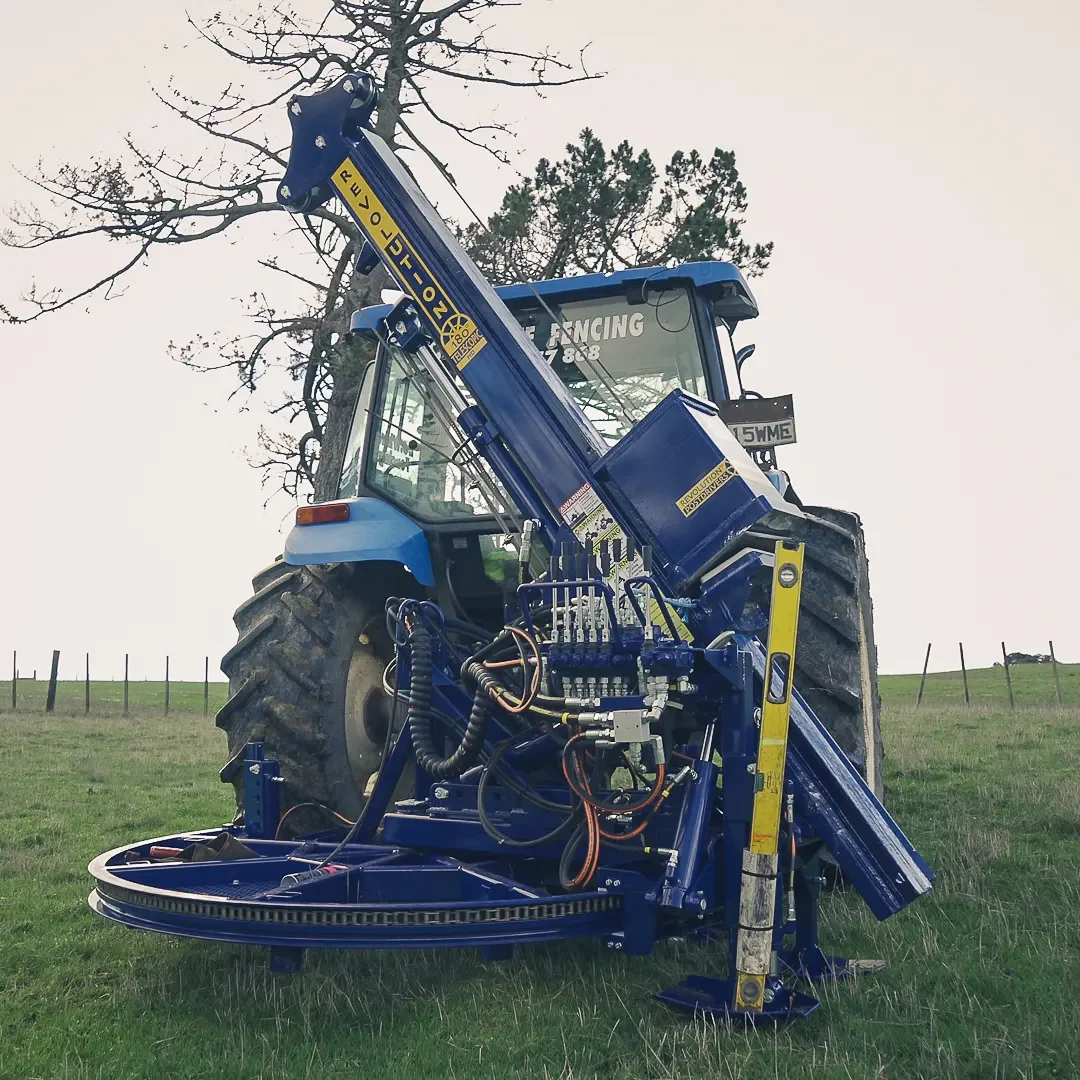
The two-pack sandblasted finish has been standard from day one. Where the competition's gear is bubbling and rusting at 10 years, a 10-year-old Revolution still looks blue. That's not cosmetic, it tells you about the standard of work right through the build. Stand one next to some of the alternatives, with their valve banks stacked up like a big piano accordion, agriculturally large and ungainly and just not well thought out, and the difference is obvious. Buy a machine that looks tidy and you're buying one where the thinking was done properly.
How it feels to run all day
The things you notice are the ones that compound over a full day: smooth action, controls that stay where your hand expects them, and kit that never gets in your way. None of it shows on a spec sheet, and all of it is the difference between a machine that's tolerable for an hour and one that's still comfortable after a few thousand posts.
Everything moves on UHMWPE wear pads, and this one's worth a close look, because other brands fit UHMWPE too. The difference is how it's applied. We spread the pad across a wide bearing surface so the load carries evenly, the action stays smooth, and it wears slowly. I've seen other ones out there with a block of it slapped in, just so they can say they've got it. A block is point loading, all the contact in one spot, so it wears out fast. Same material, completely different engineering.
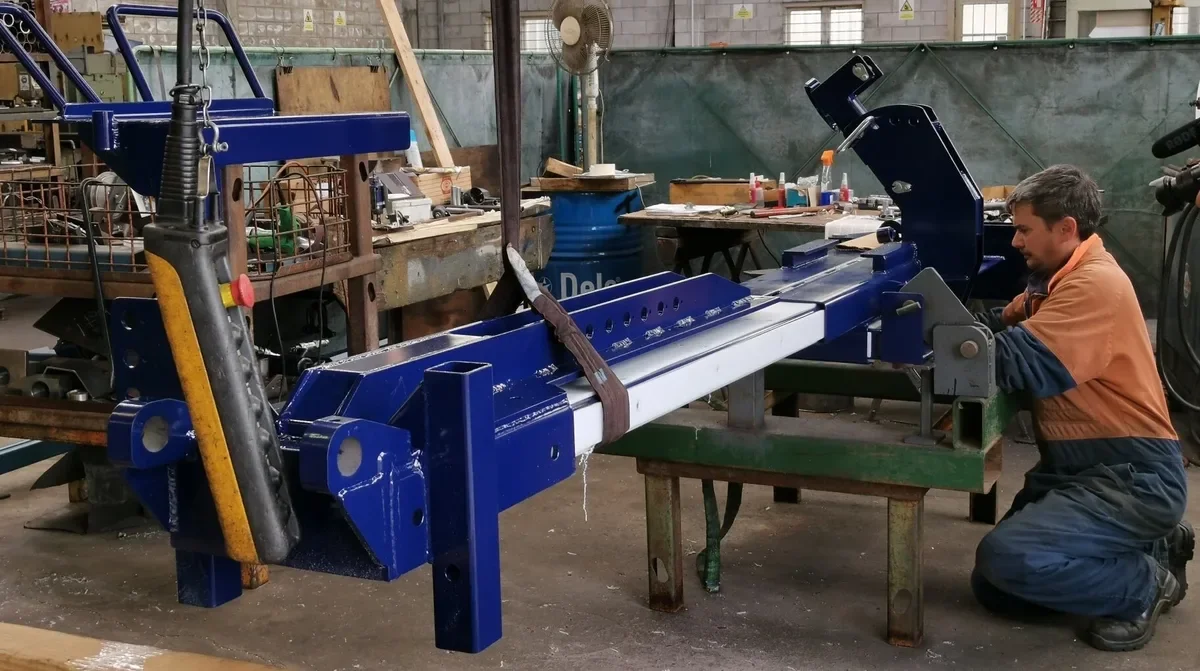
The valve bank mounts to the base, not the mast. As the mast throws out, the controls don't rotate with it, they stay level, so your hand position doesn't change throughout the day. Walk up to one and everything's right there, comfortable, and as you move the mast out the valve bank stays put. There's a health-and-safety side to that, but the plain point is it's less physically demanding over a long run.
The hammer runs off a single dedicated valve, with every other valve supplementary to it. The accessory kits, auger or rock spike, mount behind the mast, out of your sightline, so you're not reaching around them or watching hardware in the corner of your eye while a post goes in. It all deploys hydraulically, and when it's not needed it's out of the way. Small things, but the things that add up over a full day are exactly this kind of small.
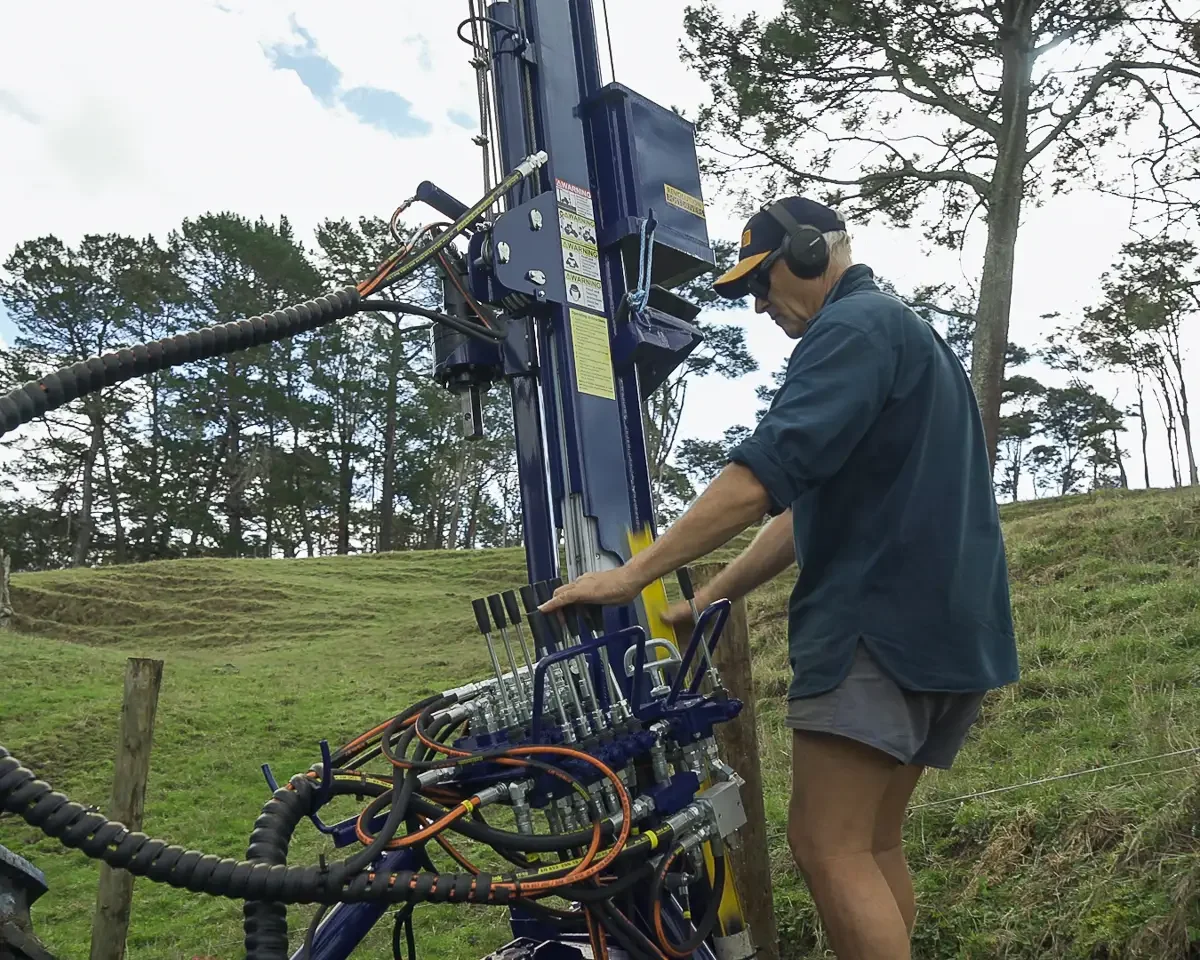
An example of the independent valve bank staying put while the mast moves to plumb.
How long will it last, and what does a rebuild cost?
Look after one of ours and it'll run 20-plus years. Our oldest machines in the field are 25 years old and still working in contracting, and the prototype is 30-plus years old and still contracting in our own business. That's possible because we design the wear in: the parts that take the punishment are built to be renewed, not scrapped with the machine. Right now, in 2026, a worn 10-year machine can be refurbished back to near-new for less than a quarter of what a new one costs. An average refurb on a machine 10-plus years old, done by the manufacturer, runs around $6,000 to $10,000.
Every sliding face except the hammer runs metal-on-plastic, and the UHMWPE plastics are replaceable. The bottom metre of the hammer's slide mast face is Bisalloy, which takes the multiple hits on every post, and that section is made to be cut off and renewed if it needs it. Basic work: refit the plastics, change the pins, renew the sliding face. The structure stays untouched, and it's a quarter of the cost of a new machine. Running it right helps too: with the hydraulic legs fully extended, they carry the load and take the strain off the rest of the machine, so everything wears slower.
The refinement behind that is real. We find issues in our own gear, with our own work, and fix them before they become your problem. That's the loop the others don't have: they find their failures through warranty claims 18 months to three years after a machine ships. We moved to a 50mm shaft on the main as an improvement over the 45mm pin, and changed the way it was welded, and since that change we've never seen a breakage. If you're thinking in terms of 10 or 20 years, the rebuild economics change the real cost of owning one. Run the numbers with our finance options.
Who designed it
It matters because the small decisions that make a long day easier only come from someone who's run the machine all day himself. A fencer who designs his own gear catches the problems before they ship. An engineer who's never been on the line catches them through customer complaints, often years later.
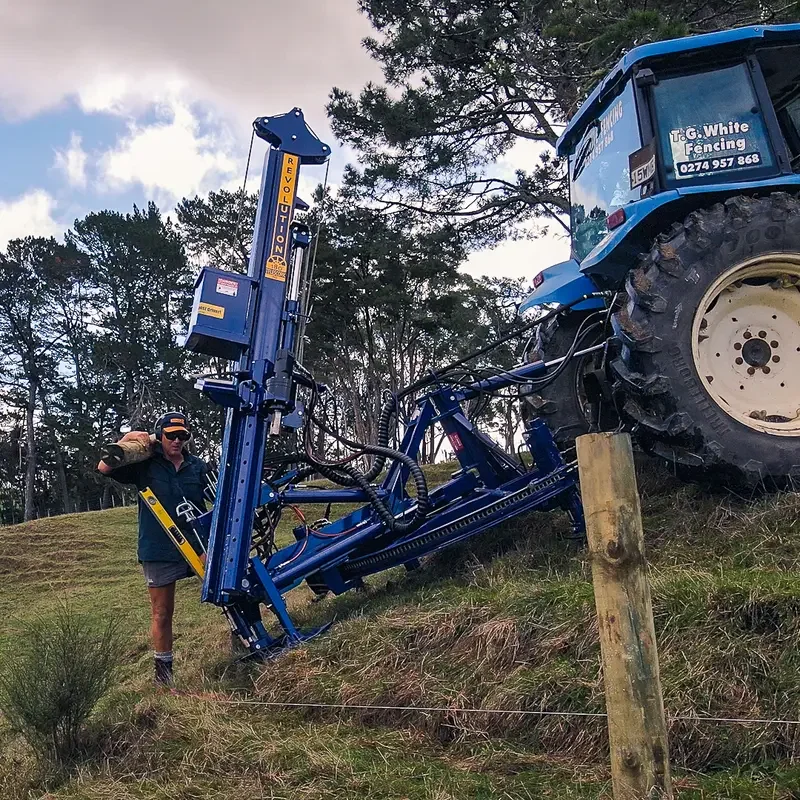
Tony White operating the Revolution 180
I've run White Fencing for more than 30 years, and we designed the Revolution range for my crews first. A lot of the refinements came from running the machine daily and hitting its limits myself. We also take feedback from fellow Revolution owners who work across different environments to us, and combined with our own first-hand knowledge it helps us engineer a machine that fits any situation. We've built up great mutual relationships with many of our customers, and that's what makes the Revolution brand.
The first rotational post driver came off a sketch I did in the dirt. The others told me it was a waste of time and nobody would want it, and now every serious competitor builds a rotational of some kind. The concept won the Equipment Improvement Award at NZ Fieldays in 2003. Human nature means people don't care who originated it, but we did, because we had the first-hand experience and the know-how.
So, which is the better buy?
At a similar price point, a Revolution is better balanced, better built, longer-lasting, and easier to run all day. It's just a nicer machine to operate. Factor in the smaller tractor it sits on, the rebuild cost around year 10, and the years of work you'll get out of it, and the total spend tells a different story than the sticker price.
The other thing you get is me, a fellow contractor. Not a salesperson handed a spec sheet, but the bloke who designed it and can tell you why every part is the way it is. If you want to know whether it's the right machine for your operation, come and talk to us.
Frequently asked questions
-
It depends on the weight of the machine. A kitted Revolution 180 runs on a 75-horsepower four-wheel-drive tractor, and I've got several working on 70 to 75-horsepower units. Heavier two-tonne competitor rammers force you up to 150 horsepower or more, which roughly doubles the cost of the tractor underneath. On hill country, lighter is better for access and stability, so match the post driver to the tractor you already run rather than buying a bigger tractor to suit a heavier machine.
-
The mainstream market sits between roughly NZ$10,000 and NZ$38,000, and premium machines sit above that. The price gap between premium and mainstream has narrowed, so the question is no longer just the sticker figure. Weigh the cost of the tractor needed to carry the machine, the rebuild cost at around year 10, and how many years of service you'll get. A machine that lasts 20-plus years and rebuilds for a quarter of replacement cost can work out lower per year than one that wears out in five to seven.
-
Both work if the machine is built to last. Because a well-operated Revolution runs 20-plus years, an 8-year-old unit can credibly deliver another 12 to 20 years. The safest way into a used machine is a factory-refurbished Revolution: we take worn machines back to near-new specification, so you get a second-hand price with the rebuild already done and the history known. If you're weighing up a private used machine instead, check the hydraulic rams for leaks, inspect the mast for straightness and wear, test every movement, and see it working before you pay.
-
You can, but you'll lack finesse and balance. Your rammer wasn't built to rotate, so bolting it onto a separate rotational base is a compromise: the weight ends up in the wrong place and nothing's quite where it should be. A machine designed from the ground up to rotate does the lot in one, and it's built that way from the start. That's the difference between a workaround and a machine.
-
For most hill-country work, yes. A rotational base lets you swing the machine's weight to the uphill side to keep the rig stable on a slope, and pair that with a lighter overall machine and you can run a smaller tractor that gets into places a heavy rig can't. On steep, broken country, weight and balance decide where you can fence, and a rotational, well-balanced setup gives you both.
By Tony White, designer of the world's first rotational post driver and a fencing contractor of 30+ years (White Fencing). About Revolution